Appear and Disappear

Beth, Barbara and Brenda

My husband and I have a really cool volunteering assignment. We spend time, more than once a week, at a semi-skilled retirement center. We assist in bringing the group a worship meeting on Sunday among other things. Every Sunday we set up our chapel: the dining room rearranged and an added a podium and electronic piano. About a half hour before meeting we go door to door, knocking, calling out the name of the person we are visiting, walking in the room a few feet and hoping for a response. If we get one, we ask if they would like to go to church. Some of our regular attendees are usually in different states of dress, preparing to come and join us; we zip the final few inches of a zipper for them, or tuck in an errant strap, and wheel their chairs to the elevator, chatting all the time, happy to see them up and moving. Others sleepily decline but are sweet and wish us well, and we do likewise. We have been asked to avoid some residents, which we do. Because of the nature of the care center, there is a fairly rapid turnover of people who live there, and we are always on our toes, giving out our last goodbyes or else tentatively knocking on the door calling out their name, reading it from a new name plate found at the side of the door frame identifying the resident. One morning I was making my way down the hall and I noticed “Barbara W”, someone new. I had seen this nameplate here for a couple of weeks but there was never any answer when I tapped and the door had been locked. On a whim I tried again, and this time the door opened, responding to my gentle push on the handle. I called out, “Barbara?” and identified myself, taking a step in and saw her sitting on the couch. I greeted her, and invited her to join us for a meeting, but before I could finish my invitation, I had a slow spread of recognition wash over me. I once again said, “Barbara?” and added, “Are you Barbara Williams from Boulder City?” She answered expectantly, “Yes…?” I bent towards her and excitedly explained our connection. I told her who my parents were, and reminded her that she was a close friend of my mother, Anne, and that I had lived in Boulder City for the first 15 years of my life; I had been a part of the gatherings at Mr. Charleston, swim parties and picnics at Lake Mead, most of these events with our church family. Her laughter, along with the sound of the laughter of others that were my mother’s friends came back into my memory–it elicited feelings of a time of comfort and belonging as a child in a group of happy caring adults. I paused, waiting for a response, and then her own wave of recognition came, and she said, “Well for goodness sakes!”

Everything shifted and she began asking me questions about the other members of my family. I fired back the answers, anxious to cement the connection with her. She finally commented, “Anne died too young.” I nodded agreement, and shared with her that the day before this was the 41st anniversary of her passing. And now, here she was–a tangible link to those dappled days, portions of my memory dropping details and perhaps adding others. We sat together holding hands, and I cried, we both laughed. I had the feeling wash over me that my mother was reaching out through time and space to me, and I felt the love and connection to her through Barbara. After about 20 minutes of sharing stories and answering questions, I had to leave, but told her I would be back. And I came back. I visited her before and after meetings; some days I just showed up solely to spend time with her. We talked of the other women in their Boulder City group who did things together, most of their activities centering around their church community. We remembered together those days gone by, of dime-a-dip dinners at our church, of her and Mom and a few others taking days for dipping chocolates in the days when people didn’t normally do that at home. She shared a few pranks that she and her friends had played on each other; one of my favorites was swapping political campaign signs from yard to yard, and we giggled together, visualizing the outcome of the event.

I knew she was having trouble sleeping at night, so if she was dozing when I showed up, I quietly left. She was never able to join our group for church, but on one of the Sundays after a meeting, my husband and I were able to go to her room to share the sacrament with her, a holy and sacred ordinance prepared to help the one who partook recommit to a better life, aligning it more with the teachings and promises made to Jesus Christ. It was a pinnacle moment for me, to sit by her on her couch and observe her humbly bowed head during the prayers, feeling her sweetness, purity and gratitude for this experience. Other members of my family visited her, and chatted of times gone by. She often shared her concerns of her family with me, catching me up on the events of her children and grandchildren, both worried and proud. She did not disappoint–it was a gift to have her there, close and attentive.

One afternoon I walked in and before I could greet her she saw me and said, “Eva died.” I was saddened but not surprised. Some of our conversations had centered around the three in their group of friends that were left. She was well aware of where they were and how they were doing, and Eva had been struggling. The funeral came and went; she couldn’t go, but my sister Brenda did and she sent me photos and I showed them to her, scrolling through them on my phone while sitting next to her. “Well now it’s just me and Glenna.” She stared at me, asking with her eyes, “What does it take to join the others?”

A few months into this gifted time we had, I went in one Sunday morning to greet her, but she was not on her couch. Calling out her name, I made my way into her bedroom, following her answering voice, weak and soft. “What happened?!” She was lying in bed, untouched breakfast on a tray, hovering over her. She turned her head to me, barely opening one eye and said, with much effort, “I fell. Broke my hip.” I asked if she was in pain, and the answer was an emphatic and dreadful yes. I didn’t know what to do. I expressed my sympathy and concern, and helplessly stood there, gesturing my ineptness. Her eye closed again, and after a moment, I went over to her, put my hands gently on her shoulders and kissed the top of her head and with emotion said, “I love you–I’ll be back.” She smiled slightly and I walked away and out of her room. I heard her voice rise again, and with noticeable effort she called out, “Thanks for coming to see me.” The knot in my throat gave way to tears.

The next day I arrived there in the afternoon and as I walked down the hall, an aide was coming out of her room. “How’s Barbara?” I questioned and he shook his head. “Not good. Her family is gathering.” I asked again, “What do you mean, is she…” He interrupted me and pointedly repeated, “Her family is gathering.” I rushed to her door, and was taken aback with the room full of people who didn’t know me, but knew Barbara. Two of her children I had met at previous visits, reacquainting myself with their adult selves when all I had known was the child. One daughter came over to me and in quiet tones we asked questions and gave answers to each other about Barbara’s condition and situation, and at my request, she wrote down my number, agreeing to let me know of any progress.

I increased my prayers on her behalf, hoping for a peaceful but quick resolution. The next morning I left my house very early, and went to the Jordan River Temple near my home with my husband, Wally. We had taken assignments on the early morning shift as volunteers there, assisting others who came to spend time in this sacred building that day. During that morning my thoughts had been centered around Barbara, and in a moment of rest, I had to fight away tears. I purposefully changed my thoughts from how she was leaving us to her arrival somewhere else, joining her family and friends. Opening this door filled me with joy and I felt the comradery of those joining the reunion. In my mind and heart I could hear their voices, delighted and filled with laughter as they gathered. I was able to set my own sorrow aside and proceed with my work. I mused over what I had just felt and heard and took comfort.

In a few moments my assignment was to assist another woman in her temple worship, and she was carrying the name of one of her ancestors on a card, which she handed to me. I read the name–it was “Barbara.” There was a confirmation of my experience, unimagined, a nod from the other side, and fresh tears filled my eyes at the tenderness of the thought. When I got home later that morning, I listened to a message that had been left on my phone earlier by Barbara’s daughter. In the night, Barbara had gone peacefully. She had unlocked the secret of passage and stepped through.


MLK Holiday

Sometime, in the process of going along and living our lives, there are serendipitous moments that deepen our respect for the subtle but deliberate crafting by Someone who is watching over us and very interested in us as we move in and out of our days.

I am in the process of reading a book right now titled Originals: How Non-Conformists Move the World, by Adam Grant. And this week, just before we celebrate Martin Luther King and his ideals, I have come across Grant’s theory of how sometimes procrastination can be beneficial.  He says, “Once a task is finished, we stop thinking about it. But when it is interrupted and left undone, it stays in our minds. ” He uses the powerful example of Martin Luther King:

Great originals are great procrastinators,
but they don’t skip planning altogether. 
They procrastinate strategically, making gradual progress by testing and
refine different possibilities.  
During the year of his ‘dream’ speech alone it is estimated that [King] traveled over 275,000 miles and delivered over 350 speeches. While King may have deferred writing the ‘dream’ speech, he had a wealth of material at his disposal that he could draw upon extemporaneously, which made his delivery more authentic. (He waited until four days before the march [on Washington mall] to actively begin working on the address.)
As King walked to the podium to
deliver his speech, even as he approached the microphone, he was still revising
it. ‘Just before King spoke,’ politician Drew Hansen writes in The Dream, ‘he was crossing out lines
and scribbling new ones as he awaited his turn,’ and ‘it looked like King was
still editing the speech until he walked to the podium to deliver it.’ 
At the podium, King expanded the
line [from a speech called the Constitution and the Declaration of
Independence] to emphasize racial equality: ‘a promise that all men—yes, black men as well as white men—would
be guaranteed the unalienable rights.’ 
It was eleven minutes into the speech that Mahalia Jackson [King’s favorite
gospel singer, seated behind him] called for King to share his dream. It is unclear
whether he heard her, but ‘just all of a sudden, I decided,’ King recalled. He followed
the emotion of the moment and unfolded his dream. 
Before a live crowd of 250,000, and
millions more watching on TV, King improvised, pushing his notes aside and launching
into his inspiring vision of the future. ‘In front of all those people,
cameras, and microphones,’ Clarence Jones reflects, ‘Martin winged it.’
[Clarence Jones was MLK’s personal counsel and speech writer.] By the time the
speech was done Hansen notes, ‘King added so much new material to his prepared
speech that the length of his address nearly doubled.’
Half a century after King delivered
his momentous speech, four words are etched into the stone tablets of our
collective memory: ‘I have a dream.’ It remains one of the most recognizable phrases
in the history of human rhetoric, as it painted a vivid portrait of a better future.

I loved gleaning the background of the writing and delivery of this speech, and thought it would be a good share for today. Here is a portion of that speech. In addition, enjoy the James Taylor tribute to MLK, in his song Shed a Little Light.

image from Biography.com

1963 March on Washington for Jobs and Freedom – Martin Luther King Speech

https://www.youtube.com/watch?v=3vDWWy4CMhE  (5 min.)

Tanglewood Performance 2018

Shed a Little Light – James Taylor

https://www.youtube.com/watch?v=sM7j1kf46wo  (4.5 min.)

Christmas Edition

IMG_20181211_084855_050

It’s early in the morning and I just woke up from yet another epic dream that seems to play all night long in my head, leaving me a bit worn out in the morning after working so hard emotionally. My dreams are visions of family and friends, reunions and home. I am seated around a quilt with some of my sisters and friends, talking, noticing the smaller children playing around us. Then magically we are at the campfire, sharing stories and thoughts, listening to music, watching the flames as they take the center of attention in the dark night on the mountain, somewhere, sometime. Next I am strangely yet logically transported to a sunny day, the light muted beneath some trees where I am working at pruning the dead out of a shrub, the satisfying work of clipping off branches no longer needed and shaping those stems that are reaching beyond the boundaries. I hear the grownup giggle of my friends as we visit side by side, working and playing (in our unique way) in the gardens surrounding the temple. I find my grandson is by my side and I stroke his silky blond hair and study his face, little gaps between his teeth, baby cheeks and sparkly eyes as he speaks to me, telling me something he has imagined. Someone else’s tiny little hand is tugging on my fingers and I look up and there are more of my grandchildren, laughing and chasing on the lawn. How could I not have noticed them? I join the group and we hug and chat and do things together that I can’t really remember now. But their faces I remember, the intensity of their beauty and distinctive characteristics that make them who they are. Back on the mountain I am preparing food, shoulder to shoulder with one of my adult children, and the mountain somehow morphs into my kitchen at home. The familiar countertop displays a cookie jar I have that is a replica from the one at my grandma’s house, and I open a drawer to grab a towel and dry my hands. I know right where everything is. Wait a minute, where have I been all this time? I come back to consciousness as I wake up in the dark room and listen to the train rumble past on the other side of the interstate, calling out for that same person whose name I don’t recognize but the pronunciation ends with a moan, signaling they have been calling for a long time, days, even months. I hear it again as the Appalachian Mountains echo it back, distorting the single-syllabled name even more.

Amen and Merry Christmas.

High Dive

Image result for boulder city nevada swimming pool diving board

As a kid growing up in southern Nevada, summers were memorable. Situated in the middle of nine siblings I learned one thing fast–money was dear. But there was something I looked forward to every week day, and that was going to the pool. My parents somehow had afforded a summer season pass to the public pool, which was within walking distance of our home. In the morning were lessons, so the pool was closed to open swimming, and also during the lunch hour. But by 1:00 we headed out, nearly every weekday, a chorus of flip flops flipping and snapping on the sidewalk as we headed west, towels draped around our necks or else dragging accidentally behind on the hot pavement. Cross the street and brave the black top, as we called the large parking lot by the high school, where we would then cut through the open campus, past the tennis courts, and then the pool was in sight. You could hear the noise before you could actually see the pool–a hundred kids splashing, yelling, laughing, and the shrill whistle of the life guard. By this time we were sweaty from our trek and we managed to step up our pace in anticipation of being enveloped in the cooling water.

There were seasons of being escorted to the pool by my older siblings, and other times when I was one of the oldest, shepherding my younger sisters. A “baby pool” was adjacent to the regular sized swimming pool, and when I had the youngers, I would get them situated in the shallow pool and then head over to the big pool. The first jump in was always shocking to the system. Although welcomed, there was a huge difference between the 100 degree desert air and the cold water of the pool. That first plunge took me underwater where the deafening noise of the excited swimmers was muted and the bright sun was shaded in the liquid turquoise blue that somehow warped yet magnified the images around me.  After the initial pause, I would shoot up to the surface, find my bearings and shake my head like a wet golden retriever. I played water games with my sisters and friends, and we showed off our skills of somersaults, handstands, and created underwater races from one edge of the pool to the other.

There were two diving boards in the deep end of the pool, one was normal and the second, a high dive.  I learned to successfully dive off the low board, and sometimes I would even copy my brothers and try a cannonball, knees to the chest and arms wrapped around my slippery wet legs as I crashed into the water. But I wanted more, and the day came when I decided to try the high dive.

Already acrophobic,  my stomach was a little queasy as I stood in line to go up the ladder. My eyes were on each jumper as I inched forward, either obsessed or else hoping to pick up some last minute skill of proper jumping. “Keep your arms to your sides” was one piece of advice I gleaned. “Don’t try a dive your first time” was another. It was my turn and I gripped the silver aluminum bars on either sided of the rungs as I slowly, very slowly ascended, being careful not to crowd out the person above me also climbing. The rule was stay off the board until it was clear from the previous jumper. When I got to the top, I watched the one in front of me go off the edge of the board, which seemed like it was kind of in slow motion. I managed to shakily let go of the ladder and grab on to the railing along side of the board. I crept out in the direction towards the end of the board but after going only a few feet I decided I could not do it. I turned and looked back; there were already three more swimmers lined up on the ladder, blocking the way and anxiously waiting their turn. I was between them and the board. No going back. Soon it was obvious that there was a big hold up in the gears of the potential jumpers–me. I heard coaching from below, “Just look at the board, don’t look down!” “Don’t think about it, just jump.” And “Hurry, we want a turn, Go!” Somebody may have even said, “Chicken!” They were right. I glanced in the direction of the life guard, hoping for a shred of mercy but she, too, was placing her whistle to her lips, about to signal me to JUMP! I felt like the whole life of the pool had stopped and everyone was focused on my performance, or lack thereof. I thought of dropping to my knees and crawling out to the end of the board, but how could I launch once I was there, just roll sideways off the edge? I very cautiously and slowly made my way down the board, fighting vertigo and panic as I discovered the end of the board was much more bouncy than the rest of it, and at that point I knew either the drama had to end immediately or I would cease to exist, so I jumped.  I sailed through the air, trying to keep my arms to my side and as I entered the water at what seemed like several hundred miles an hour, and all the noise stopped. My skinny little brown body went as an arrow nearly to the bottom of the pool and like a mad woman I frantically started flapping my arms and legs to get back up to air.  Breaking the surface of the pool and at the same time blowing water out my nose, I quickly made my way to the edge of the pool and hung on for dear life, gasping and trying to make sense of my great personal accomplishment.

Many jumps and many years later, I’m still finding myself in the same position. Wanting more, going for it, scared, nervous, accepting some coaching, and finally the moment of truth–I just go for it!

You’re Loved

In June something happened to my heart and mind and I felt compelled to do something different and somewhat daring. This feeling led to a huge commitment and change in my life–my husband and I are serving a full time mission for The Church of Jesus Christ of Latter-day Saints.

Usually when we set out to do something big, there is a rush of energy and excitement as we press forward to make our dreams and plans become reality, but the other part of that reality is a confusing, messy and miserable part commonly known as setbacks. Others say it is opposition. As we put our lives in the hands of others, with it goes a part of our autonomy and we end up in a space of humility and sometimes we become impatient and a little desperate when things aren’t going the way we imagined it would. It is at this point I habitually start turning inward, isolate, and I lose my feeling of being centered and often my neuron paths in my head lead me to believe I am not really loved like I thought I was loved. This makes no sense, and it may not be a reality, but to me, it becomes very real.

What to do when this happens? It’s a place I don’t like–it doesn’t serve me, but yet, years of practice have rutted this road, well traveled and winding, a sad journey of self-centeredness and self-depreciation.  There are a few remedies I use to call myself back, and the simplest and most effective is music, good music. In fact, I have even created a couple of audio playlists to assist me on the road back, one titled “Pensive Release” and a second, “Well-Being.” I play these tunes which become the background of what I am doing in my life, and eventually, it helps. The product I use to make these lists often suggest songs derived through some algorithm to add to my compiled list; they have similar components to the music I chose, and therefore might seem appealing to me.

Recently, during one of these times, I came across a “recommended” song called “Lullaby.” The music is sweet and stirring, and the first time I heard it, I had to stop what I was doing and full-on listen as a vision formed in my mind. The room is slightly dark, and a mother is there, holding a fairly new infant in her arms, close. The baby has a look of serene and sleeping peace on her little face, a shine on her lips from the residue of milk left after pulling off the nipple, satisfied and full. The mother gently strokes the baby’s hair, softly, not wanting to wake the child but unable to resist touching this beautiful, lovely and perfect creation. As this video played in my head along with the music, a deep and wonderful revelation swept over me, warming me and filling my eyes with tears—you’re loved. You always have been. And you always will be.

Not the same video that played in my head, but here’s the music, enjoy.

100 Years

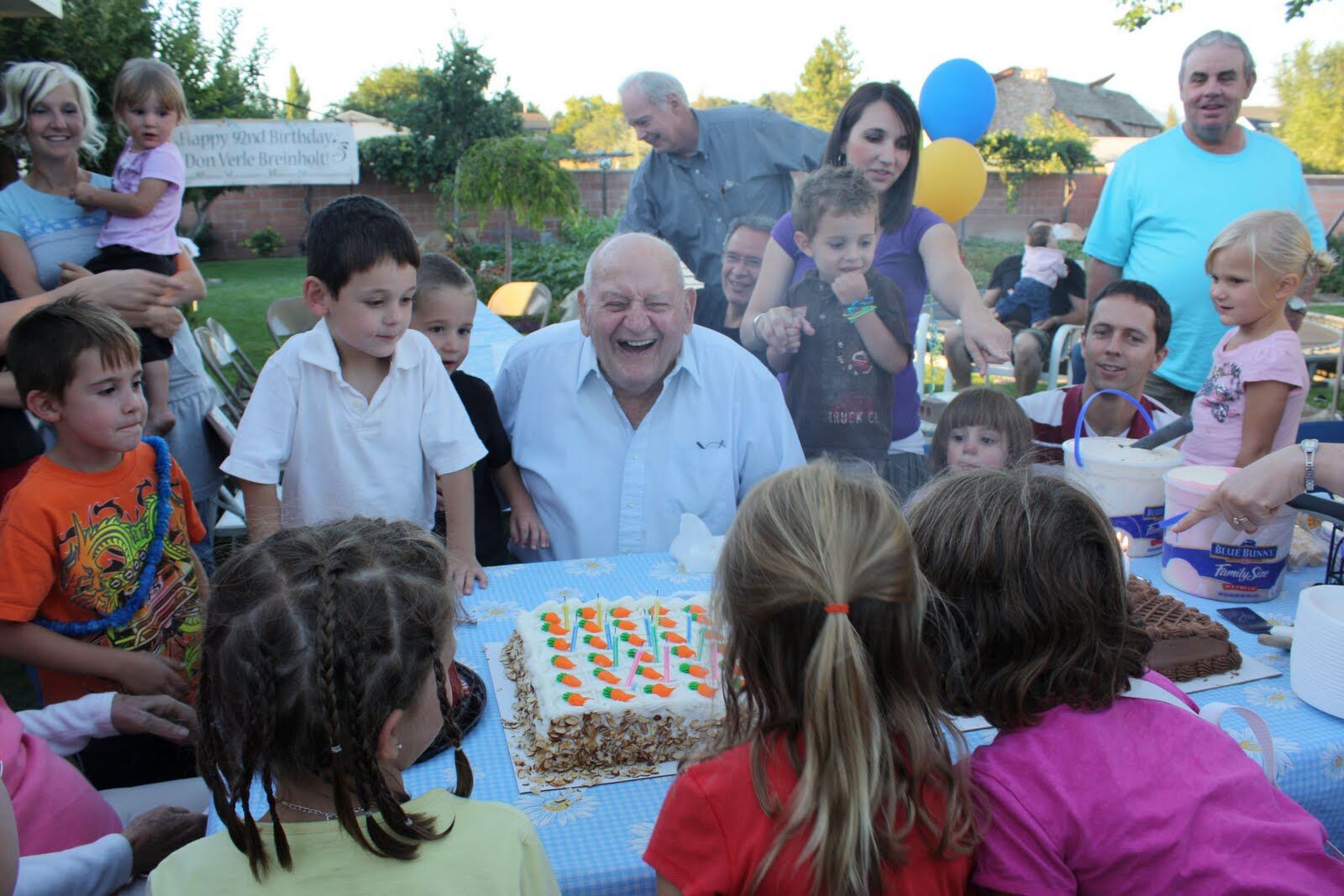
Last week we marked the 100th birthday of my father-in-law, Verle. He passed from this place five years ago, in fact, the day after his 95th birthday, so it’s easy to keep track. By his own admission, he grew up in a somewhat idyllic situation, surrounded by a multi-generational family, farm country life, aunts and uncles from both sides of the family doting on him, cousins for his best friends, plenty to eat and much to do and explore in his small yet religious central Utah community.BREINHOLTFamily Marj Roda Clare Harvy Oliver Verle-from Cleo

As his family migrated to the bigger city for opportunities and work, he did his best to blend in with his new surroundings and culture, but he always called Venice “down home,” even as a grown adult. This beginning set him up to confidently face a long life of challenge and trial, greased the gears of his ingenuity, taught him the power behind a smile and a sunny disposition, and gave him a chance to exercise integrity.  Like most kids, he created his own learning experiences by following his curiosity and innocence, and he witnessed first hand the sorrow and despair of loving parents trying to keep a growing family afloat during those depressive years.

At age 19 he planned to serve a mission for his church, which created nearly an insurmountable financial challenge for the family. but with faith and optimism, he lined up wonderful speakers (Philo T. Farnsworth was one of them) and musical entertainment for his missionary farewell in hopes to bring in a large audience with big hearts and generous donations supplementing his meager funds. He turned out to be the show stopper by producing a bloody nose when his turn came to stand at the pulpit.

Going to Denmark in the fall of 1938 was risky business with the world affairs in such turmoil, and after a partial mission there, he and all his fellow companions were reassigned to “safer” places; he went to the Southern States. The names of the rural towns he frequented are listed in his personal history: Townley, Double Springs, Sulligent, Mud Creek, Holly Springs, Decaur, Athens, Elkmont, Leeds, Sneed, Sylacauga, McCalla, Bessemer, Greenpond, Atalla, Anniston, Cherokee, Cullman, Arkadelphia, Tusculoosa, Hamilton, and Red Bay. He collected people–he loved them–and remembered their names, too: Roberts, Evans, Browns, Griffens, Locks, Gaylors, Silveys, Randalls, Moores, Smiths, Ganns, Mitchells, Eaves, Youngs, Hicks, Vinning, Brockners, Sanders, Ackers, and Largens. That was his mission, but throughout his life he continued gathering people, knew their family members and stories, and carried them with him.

He met and married a Southern belle, and although not wealthy, she was a treasure and true to her well-mannered and principled upbringing. After a few short months, he went off to war in Germany, given the incredibly impossible job of switching from saving souls to destroying lives. He quickly became a leader and did the task he was charged with, and in the process earned medals (for which he never comfortably accepted any adulation) and headed up the force which freed Buchenwald concentration camp (which he couldn’t talk about for over 50 years) and then rode a ship back to the U.S., welcomed into the New York harbor by Lady Liberty (an experience he never related without choking in his voice and tears).

He put those three years behind him and jumped into life, built a home, raised a family of ten children (his own basketball team plus subs and a couple of cheerleaders). He joined a family business with his dad and brothers laying brick, creating work opportunities for his own children. He loved being involved in his community and found ways to serve in his church. He and his wife also piloted a Cub scout program, he coached little league teams, and they raised animals and a huge garden on an acre plus behind his home. Then as the kids started leaving, he and his wife collected strays, listened to their stories, bound up their wounds. Gladys fed them and Verle employed them, and gently sent them on their way when their visitors were once again grounded.

Soon a second family of sorts began to form as everyone married and produced the best crop of all, grandkids.  The history goes on and on. . .

How do I know these few details, plus endless others? Verle wrote down his history. He put in little bits of interesting information everywhere, just like in life; he was a collector: rocks from the Hebron Brook in Israel, notated with black permanent marker, dated maps from Germany that directed him and his tank destroyer crew across the foreign terrain, marbles made from Redmond clay originating from his youth, feathery cotton still in the dried husk from a South Carolina field–you name it, he had some meaningful artifact holding a portion of his collective memory of life experiences, 95 years’ worth.

In the last few weeks of his life, he was stuck in his bed, but, still smiling and positive, he embellished each day with a recitation of the names of all of his descendants: kids, married-ins, grandkids, great-grands, pushing the numbers up to and past 125 before his death.

Verle's birthdayHappy Birthday, Verle. Thank you for including me in your collection.

(photo by Tiffany Breinholt)


Searching for Thirza, part 4 – Conclusion

Thirza’s son Ormus was ten years old when he lived in Springville, Utah with his father and two brothers. Sometime during that same year, he gained a step-mother, Thankful Lucy Pine. Family lore says Ormus felt she was “like and angel to us;” apparently he appreciated her love and attention. The family moved to southern Utah and he grew enough during the next ten years to feel confident in wedding the 17-year-old Louisa Ann Earl, a young and beautiful woman living in the same town where they lived, Pine Valley, Utah. Ormus was a miner who did a few other odd jobs on the side, and the birth places of their children tell the story of the movement of the couple, from Harrisburg, Utah to Silver Reef, both cities in Washington county and known for their mining in the late 1870’s. From the book “Nay Family in the West” comes a description of what happened next:

“At this time, a very dark and trying event occurred deeply affecting this family. Ormus was involved in a train robbery and sent to prison.  In the Nevada State prison records dated the 9th of February 1883, we read that Ormus was charged with ‘the crime of assault with intent to commit Robbery,’ occurring on January 22, 1883, near Montello, Nevada, to which he admits guilt.”

It was this very act and incarceration that led us to the next clue to Thirza’s whereabouts. As we investigated the paperwork in Ormus Nay’s file from the prison, we discovered a letter written to him from his mother, Thirza. She wrote in behalf of her son Ormus B. Nay who was there in the prison, and pled for his early release hoping that his aged father and mother could once again see their son. She was convinced he was repentant and said “He was not a bad boy but bad company has brought him where he is.” A most poignant sentiment closes the letter: “From his aged mother whose hope is in the God of justice and mercy.”

From various and sundry records, we had previously suspected and believed Thirza and her run-away husband, the soldier James, had changed their last name to Marley, and true enough, the signature on the letter is “Mrs. T. A. Marley.” The most important thing about this letter was that it was dated May 23, 1892 and it came from Monroe, Utah.  We know that she was alive and living in Monroe more than 30 years after her purported death before John Nay’s marriage to Thankful Lucy in 1860.

During the two to three year period of our search for her, we had enrolled other cousins in the adventure, resulting in a second and then third important find. A year or so after the discovery of the prison letter, Allen Nay, our second cousin, notified my sister about a “Pony Express” bible for sale on Ebay. There was an important inscription:  “Circle Valley March 26, 1887 Present from your Darling mother Thirza Angelina Marley to her Son Ormus B. Nay.”  Apparently Ormus received this gift from his mother during the time he was imprisoned, when she was living in Circle Valley, which is in Piute county, Utah, about 30 miles south of Monroe. My sister purchased the bible, and ended up connecting with the seller, who was also a cousin, but that’s another story.

CapturebibleWe wound up with two solid pieces of evidence contributed first hand by Thirza. So when did she die?

Another second cousin, Scott Bowen, who was helping us compile the book on this Nay family, decided to rustle through a stack of old papers and forms he had inherited at his mother’s decease, and found an odd manuscript titled “Record of Family Traits” dated 1915, which had been partially filled out by Frances Ellen Standley Warren, his great grandmother. who was married to the grandson of Thirza. Part of this U.S. government-generated questionnaire had a place to write down the birth and death dates of the parents and grandparents of the individuals working on the forms, and, against all odds, the death of Thirza Angelina Hale was written in as 1 October, 1895.

It was time to cross off “before 1860” from the genealogy sheets and legitimately fill in a date that we felt could be correct. But where was she buried? We don’t really know, some old-timers from central Utah say they swear they have seen a headstone before with Thirza’s name on it there in the “old” Monroe cemetery; others just scratch their head and admit they don’t really know. At this writing we believe she was likely buried in the Nay cemetery plot there in Monroe, Utah. All eight graves are occupied, but two are unidentified, and, she spent time in that area in her later years. No further mention of the wayward James Marley has been yet discovered. Her “sister-wife” Thankful Lucy died two years after she did, and her grave is marked, next to John Nay’s grave.

As I reflect on this small uncovered portion of Thirza’s life, I reiterate her fitting words: “Hope is in the God of justice and mercy.”  Love you Thirza, can’t wait to meet up with you.

Elko Free Press 1893 P.S. Unfortunately, Ormus’ father never did see him again as John Nay died a year before O. B. Nay was released from the Nevada State Penitentiary, and resumed his life with his family, fathering two more children with faithful Louisa.  but that’s another story. . .
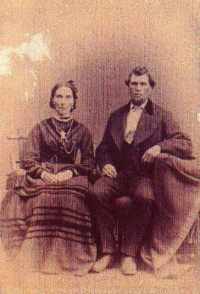
To read the full adventure stories of John Nay, Thirza Angelina Hale, Ormus Bates Nay and Louisa Ann Earl, follow this link: The Nay Family in Utah and the West

Searching for Thirza, part 3

cedar fort

Cedar Fort, Utah (from Utah State Historical Society)

When Thirza Angelina Hale Nay settled in Cedar Fort, Utah, she was in the company of other families of settlers, but living there was challenging to say the least. From the book Nay Family in Utah and the West:   “Life in the uninhabited Cedar Valley was  not easy. Logs for homes and the fort had to be brought from the nearby mountains. Water had to be directed for irrigation and gardening. And the Indians proved troublesome.” It was a far cry from the lush and green hills of Vermont and New Hampshire, where she had been raised, or even the rolling plains of the Midwest where she had traveled and camped with other saints since leaving Nauvoo.

This was not the only challenge. As the attacks from the Indians subsided, a new problem came on to the horizon. From the book again: “That re-commitment to gospel principles may have been sorely tested two years later when Utah residents learned that President James Buchanan was sending a large contingency of soldiers to the territory to put the the so-called war against federal authority by the Latter-day Saints.  In reality, the “war” was emotional rhetoric on both sides debating Utah Territory’s request for statehood. Among other things, the practice of polygamy was at the head of the list of the emotionally charged debates.”

In 1857, amidst the physical threats and challenges came a new personal one for Thirza. She and her husband John received a second Patriarchal Blessing (a blessing “given to worthy members of the Church contain[ing] personal counsel from God.” lds.org). The wording of this blessing indicated she may be called to live the law of polygamy, and apparently she drew the line. We don’t really know what happened for sure, but her struggles were culminated in 1858 when she was excommunicated from the church that had brought her and her family west.

Thirza did leave John and the community sometime thereafter, as recorded in a manuscript account found in the LDS Church Archives, titled A barefaced case of Abduction.  This tells the story of a soldier who was introduced to the family of Mr. John Nay and a “too familiar intimacy grew between the corporal and Nay’s wife.” According to this report they were married on the 23rd or 24th of November 1858 by a justice of the peace in Cedar Fort, and then disappeared.

Little is know of James Haven, the soldier in question who “abducted” Thirza; in fact little is known of Thirza after that time. But a few clues of her whereabouts came forward when we continued researching the family, starting with her son, my ancestor, Ormus Bates Nay, who robbed a train . . .

To be continued

Searching for Thirza, Part 2

Thirza Angelina Hale was born February 23, 1814. She was my 3rd great-grandmother. When she was 19 years old, she married a man ten years older than herself, John Nay, Jr. In 1841, the couple was living in New Hampshire, and were baptized in The Church of Jesus Christ of Latter-day Saints. A few years later they moved with their young family to Nauvoo, Illinois area, joining a well established community of others sharing their religion, commonly known as Mormons. By 1846, the religious sect was driven out of the area and headed west. John and Thirza moved with the group, and temporarily settled in a fertile valley called Harris Grove in the state of Iowa. Here Thirza gave birth to twins; one of them lived, Ormus Bates Nay. He was my 2nd great-grandfather. The family eventually moved further west, traveling with an emigrating company led by  Allen Weeks towards the Salt Lake Valley in Utah. The journey lasted 2 months and 26 days; the company arrived in the valley October 12, 1852.  Once they reached the body of saints, however, they were asked to move on south and west to an area now know as Lehi, Utah, where they camped for a month, and then went even further west, settling an area called Cedar Valley. Here in this desert area populated with sagebrush, Thirza gave birth to her youngest child, Angelina Relief Nay.  The settlers erected a fort for protection, and the appropriate name given to their town was Cedar Fort.  This was the history our family had of Thirza Angelina Hale Nay.

Back to my genealogy project: (See Searching for Thirza, Part 1) As I examined the family group record showing Thirza’s marriage to John, and then his subsequent marriage to Thankful Lucy Pine, I noticed Thirza’s death information said “before 1860,” and that she was buried in Monroe, Sevier, Utah.  This was about the time John married Thankful Lucy. I wondered why there was only an approximate year for Thirza’s death when so many other details about her life and travels were known. I determined I would visit the cemetery there in Monroe and see if I could ascertain the date myself. I called my sister Joy and we headed out on a road trip with her husband driving and Joy and I talking, mostly genealogy.  When we arrived in Monroe, we combed through the quiet and surprisingly shady cemetery in this little central Utah desert town. We located John’s grave, and also Thankful’s, but no Thirza. We made a visit to the tiny and personable city office there, and searched the sexton’s records for a burial, but nothing was found. We discovered there was an 8-plot “family” section where John and Thankful were buried, but not all of the occupants of the graves were named. We searched other cemeteries within the surrounding areas, but no Thirza. We drove home disappointed, a little frustrated and even more curious.

We began reaching out to second and third cousins, trying to find out any additional information about Thirza’s death and the rumors started. One family said they heard she had deserted the family, but no one was really forthcoming with any details about her. We got the distinct impression from other branches of the family, especially descendants of John’s second marriage, that she had done something non-traditional, and her history was better left uncovered. But Joy and I had other ideas.

An 1860 U. S. Census of Springville, Utah showed John Nay living as a widower with four of his children. His son Ormus (my ancestor) was 10 years old. The information on this record explained where the date on our family group sheet originated, and pairing that with the marriage of John to his second wife Thankful in 1859-60 should have satisfied our curiosity and drive to nail down details. But it didn’t. What of the bits and pieces of family stories that were circulating like ashes above a campfire, shooting out red hot sparks of live information which quickly turn to gray as they were examined more closely?

Through all our cold contacting and questioning, someone told us to talk to a person named Joan Nay. She could tell us about Thirza. We found out she was a long time employee for an established bookstore downtown Salt Lake City, and we tried to contact her by phone but our efforts failed. At that point I decided to visit the store in person. I remember the day. It was early November, but not quite as cold as it should have normally been. The sun on the grey and white buildings downtown convinced me to wear my sunglasses as I walked up Main Street, looking for the store. A white butterfly unseasonably alive fluttered back and forth in front of me as I waited at a corner for the traffic signal to change so I could cross the street.

Thirza and Morley Haven

Thirza and Morley Haven

I asked for Joan Nay when I got in the store, and a busy clerk sent me to Acquisitions, 2nd floor.  I made my way upstairs and hunted for the alcove-type office, tucked somewhere between the floor-to-ceiling bookshelves. I found her office and I found her. Like the other Nays I had interviewed, she was just a bit reluctant to tell me what she knew. (I now know a family trait is shyness and a tendency to avoid others.) As she bustled around the bookshelves, rarely making eye contact, she finally told me the story she had found, in bits and pieces, sandwiched between questions for me concerning my interest in the life of Thirza. Like Joy and I, Joan had a driving passion to know more about this woman, and had spent 20 years searching out her life. For the first time I heard details of a story about Thirza Angelina Hale Nay, who had left her family and the area with a soldier from the famed Johnson’s Army, then situated at Camp Floyd, close to Cedar Valley.

To be continued. . .


Searching for Thirza, part 1

Several years ago, in the day of kludgey desktop monitors and dot matrix printers, I electronics-waste-recycling-old-CRT-monitorassigned myself the task of transferring all of the genealogical records my mother had researched, accumulated and organized her whole life into my new computer system. The software I had was brand new, called “PAF” I think. The device I was using ran with a DOS program, ancient now, but at that time it was pretty much cutting edge for me. I was excited with the goal I had set for myself, and spent many a day working at the black and white screen, entering little numbers and ciphers that translated into my family history.
I had two consultants, one was my teenage daughter Mimi who understood the computer better than I did, and the other was my sister Joy, who has ended up as a willing partner for all things family history. In the case of my daughter, her expertise and intuition saved me and kept me moving forward. I did not understand a lot of how my computer worked. For example, when I turned it on and tried to initiate running of the program, sometimes I couldn’t get it to go, and would receive the message “<Bad Command or File Name>.” I would feel my frustration build and try to argue back with the computer by typing in my response of how I felt about this message. I would always get the same answer, of course. So I would summon my daughter and she would patiently make the needed corrections until I was in! There were other things that mystified me, too, and as I would work, I needed her help often. This became a problem when she was in school, so I did the unthinkable—I bought her a cell phone in the days when it was rare for a teenager to own one—with the stipulation she must answer it anytime I called. I dialed her number and I would hear, in a very muted voice, “Mom, I’m in class.” I would say, “Step out in the hall, I have a question.” She would do so, much to her chagrin, and coach me through my snafu. The solution often began with “Okay, remember Right Click? On the mouse? Do that and tell me what you see.” I soon learned the value of right click and began to slowly assimilate and understand the choices it would offer me.

It was strange, but I loved the seemingly monotonous work I was doing. The names of my ancestors streamed through my head like music, and as I entered the data, I visualized their families and thought about the places where they lived. I calculated how old they were when they died and noticed the children who died young, and wondered how it all happened. I knew some of the stories, and those familiar to me were silently rehearsed and I remembered them as I typed their names and other information into the program. Some of the towns like Panaca, Nevada became little chants in my brain and others made me wonder about the Germanic languages that used several consonants in a row to describe a place, knowing I could never pronounce it on my own, but I did fantasize about someday visiting there, seeing blue-skied harbors on the ocean and smelling that pungent salty-fishy freshess.

One morning I sat down to continue the work I had initiated, and the screen of my computer was acting very ignorant and not responding. I tried everything, but to no avail, so I called in the big guns–my daughter, who for the first time, was unable to help, then my husband, a guy who invented computer chips for a living. The prognosis was tragic. The computer went down, taking everything with it, of course, including all of the genealogy files I had trustingly stored inside it, pretty much the only important thing I had on the device.  Hours and hours of work disappeared off into the blue, like a helium balloon from the hand of a careless child.  I pouted and ranted for a few days, waiting for my husband to replace the old equipment. He had hookups at work, and soon he came bearing my “new” computer. He connected all the pieces together, turned it on, taught me about backing up files, and I was again in business.

With relish and new determination, I faced my task once again. This time, I was much Thirzaeditmore familiar with how to run the machine and with the names of Thankful Lucy Pinethose people with  whom I shared my genes. (Hooray for second chances!) During this process, two names in particular kept coming into my mind, Thirza Angelina Hale and Thankful Lucy Pine. I determined when I completed my job, I would look more closely at their information and see what it was that was drawing me in.  After several weeks, I finally came to that point, and discovered to my surprise these women were married to the same man.

To be continued. . .